X
Nuclear Power and Waste Applications
H3D® products are perfectly suited to the nuclear-power and waste industries. In fact, close cooperation with power-plant leaders in radiation protection and chemistry has been key in the development and refinement of many of the instruments listed here. Our systems are used at over 75% of US nuclear power plants as well as many plants worldwide.
Source Localization and Visualization
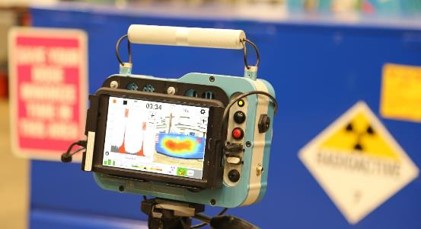
H3D's first industry offerings were focused on leveraging CZT-based detection methods to provide high-resolution portable imaging spectroscopy. This allows for quick understanding of what source(s) are impacting dose rates to workers and where these source(s) are located. These instruments provide instant feedback in the field with real-time spectroscopy and radiation overlay images. Visualizer post-processing software provides more powerful analysis options, including SourceTerm point-kernel modeling for activity analysis. Results can be used to identify and validate dose mitigation actions, provide excellent visuals to support worker briefings and work planning, and identify changes to the source term over time.
As examples:
Verify the Adequacy of Temporary Shielding
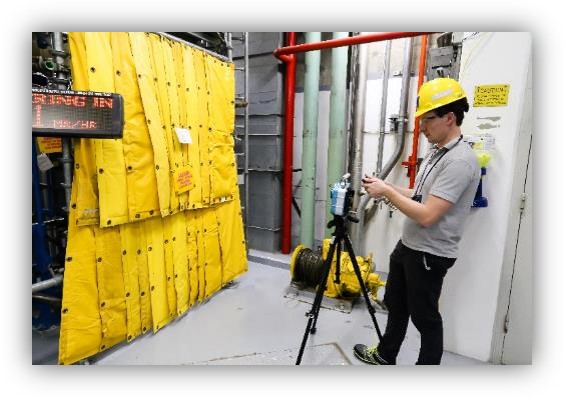
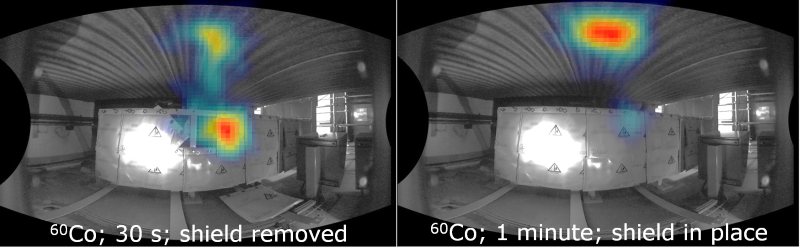
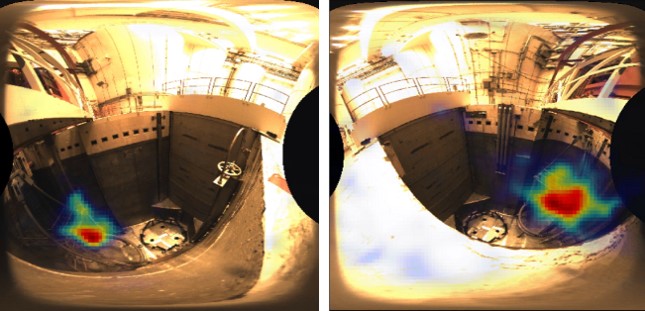
Early on, nuclear power plant customers recognized the power of using H3D imaging spectrometers as a tool to assist with optimizing shielding applications. While dose-rate impacts from installed shielding can be measured using traditional dose rate meters, H3D's imaging spectrometers provide the ability to visualize the resulting conditions, identify gaps in the applied shielding, or find other opportunities to improve the effectiveness of the shielding package. The ability to quickly identify the specific radionuclides being shielded can assist in optimizing the required shielding thickness for the dose-rate reduction required.
The photo above is showing an example of before-and-after imaging. On the left is an image that shows a "gap" in shield. On the right, the shield is replaced and the radiation overlay image demonstrates that the post-shielding conditions are improved - the larger dose impacts are now coming from the overhead instead of the component(s) that have been shielded.
As further examples:
Site Surveys
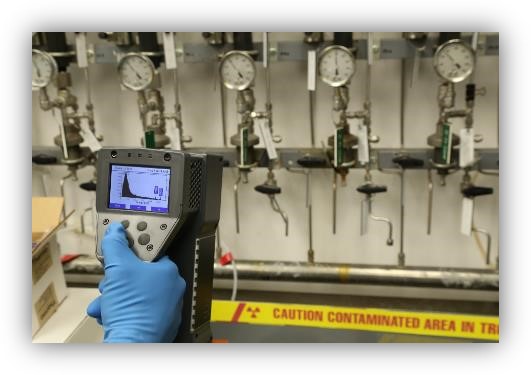
H3D spectrometers can be used to supplement the plant's radiation survey program. The visualization/directionality capabilities of the instrument can assist with ensuring that the most-impacted areas of a room, container, or component have been captured - for instance, the radiation overlay image can help ensure that the highest dose rate on a shipping package is measured by the survey. Testing has shown that H3D instruments also provide accurate dose-rate information, consistent with industry standards like ANSI N42.17 and N42.34. And, of course, surveys performed with H3D spectrometers provide radionuclide-specific information that is lacking on traditional dose-rate meters.
For example:
Radiologically-Controlled-Area Exit Point
When armed with H3D spectrometers, technicians have identified additional uses at the RCA exit point. The radionuclide-specific results can be helpful when responding to an alarm at the exit monitors or when assessing the potential impact of background/NORM on exit-point instrumentation.
For example:
Radionuclide Trending and Source-Term Monitoring
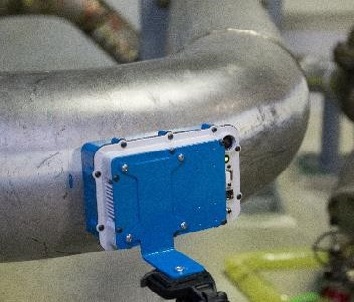
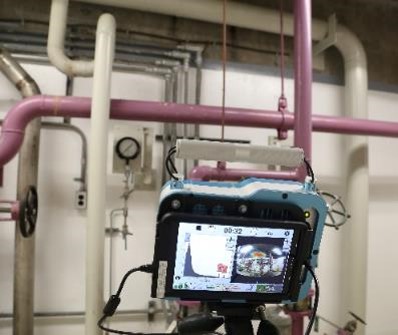
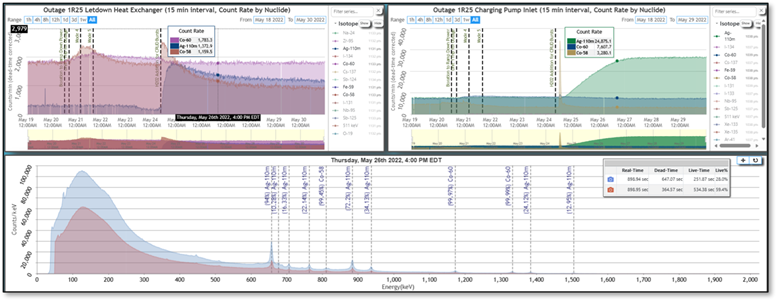
H3D's GammaTrend system leverages the field-deployable, high-resolution CZT spectroscopy to provide real-time source-term trending of the reactor coolant systems. GammaTrend provides minute-by-minute results coupled with powerful trending software equipped to monitor the source-term impacts and investigate reasons for changes in the process stream.
Plants use GammaTrend to:
GammaTrend instruments (typically S100 or P100S) can be deployed over long periods of time (years or operating cycles) with minimal attention required to keep the system operational, which allows for "outage vs outage" or "unit vs unit" comparisons.
See this article for a more complete write-up highlighting the GammaTrend system.
Shipping, Waste Characterization, Cargo Inspection
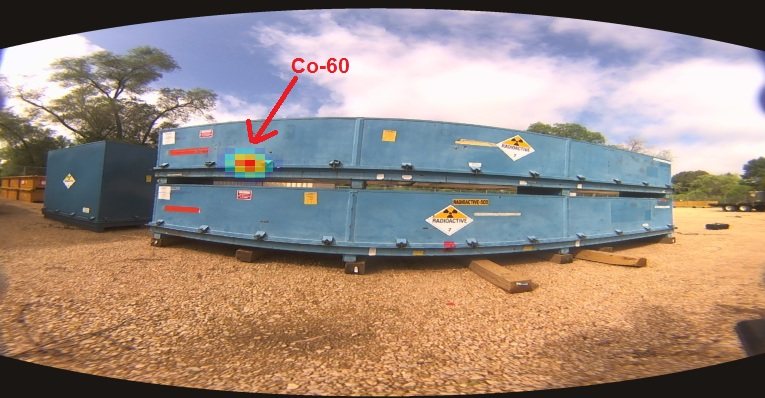
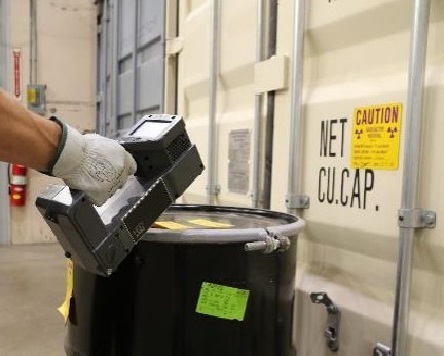
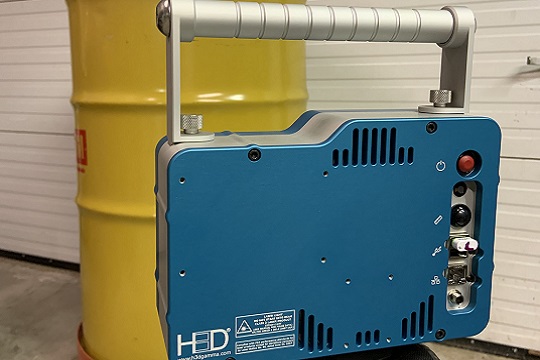
Field-deployable spectroscopy is especially useful when supporting the plant's radioactive material/waste shipping and characterization activities. Visualization of radiation, radionuclide-specific results, accurate dose-rate measurements and quantification of container radionuclide contents are all critical components of a successful shipment.
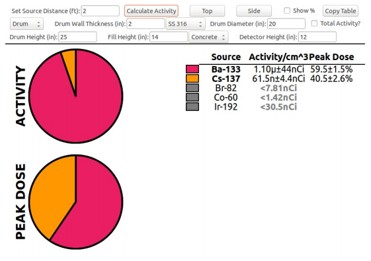
H3D instruments have performed well (and on par with HPGe-based platforms) in blink-spike studies using waste-applicable containers, as described below.
Example uses include:
SourceTerm at the Nuclear Industry Proficiency Test Exercise 2019
The H3D H420 was used in conjunction with SourceTerm software package at the Nuclear Industry Proficiency Test Exercise in 2019.
Prior to measurment, a waste drum was spiked with Cs-137, Co-60, and Am-241. The location of these isotopes was not disclosed
before measurements were taken.
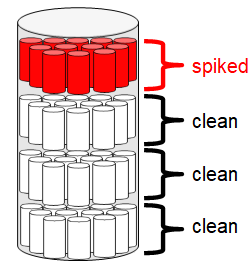
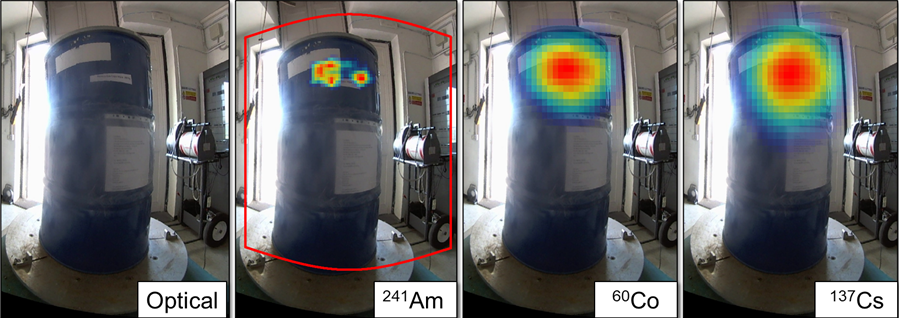
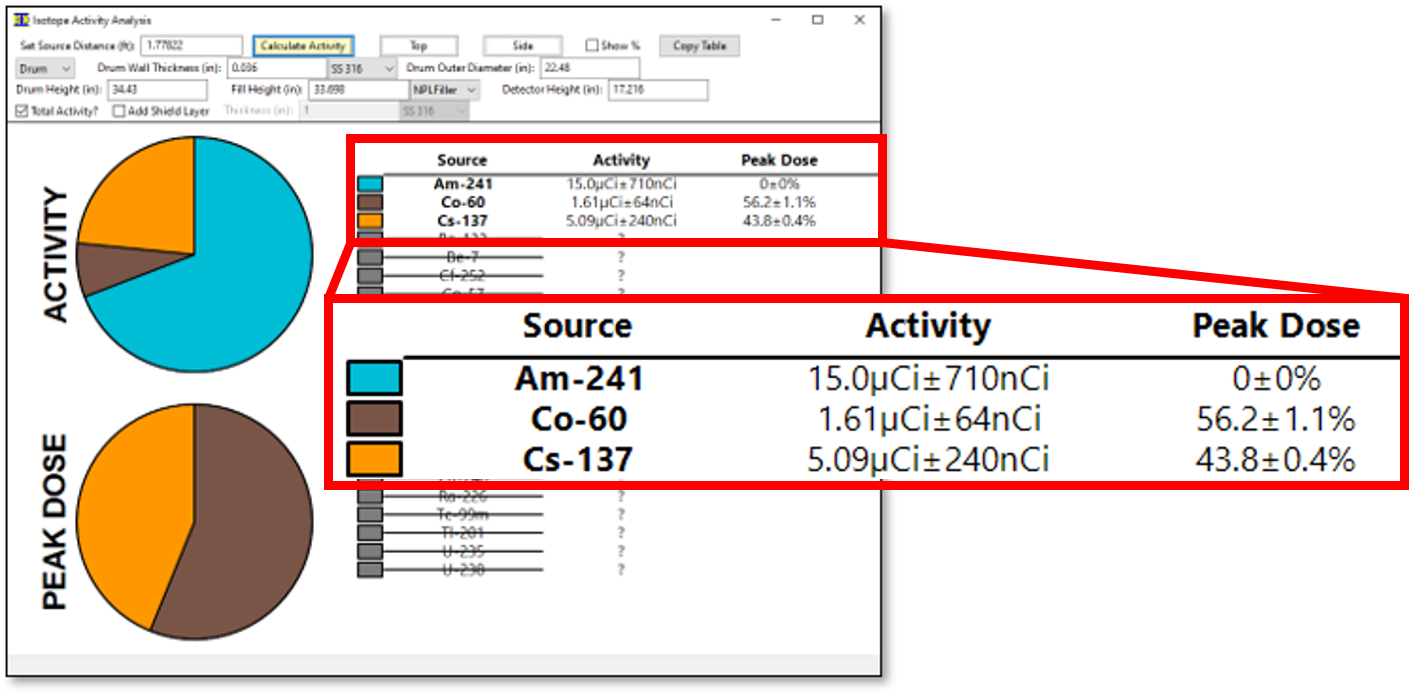
The H420 was able to locate and identify the source package in the upper chamber of the waste drum as Am-241, Co-60, and Cs-137 (shown above). Using SourceTerm in post-processing, the source package was further analyzed and accurately quantified (shown to the left).
Decommissioning and Dismantling
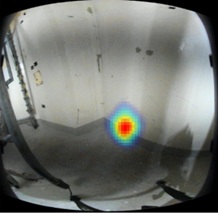
Detecting radioactive contamination that is of similar strength to the natural background is difficult, but necessary, during decommissioning and cleanup.
Higher-efficiency CZT detectors, such as the H400 and H1600, offer a number of advantages in this environment, including high imaging efficiency, isotope discrimination, and portability. High imaging efficiency means that it can make an image of gamma-ray intensity isotope-by-isotope in a reasonable time, even near background levels. Given enough count time, these units are capable of detecting and imaging sources weaker than natural radiation background. Therefore, H400 is a good tool to identify residual contamination that need to be cleaned. Once these are identified and cleaned, a standard, non-imaging detector can be placed close to perform clearance measurements.
As an example:
H3D, Inc.
Ann Arbor, MI, USA
©Copyright 2014-2026


Contact Us
Privacy Policy | Conflict of Interest Policy