
X
Introduction
The RhIsotope Project utilizes nuclear science to support a unique anti-poaching program to deter trafficking of rhinoceros horns. Small, but detectable, quantities of radioactive material are inserted into the horns of these animals such that trafficked horns can be caught at international borders. Furthermore, "radiophobia" make any rhinoceros horns less desirable on the black market, deterring poaching.
The RhIsotope Project currently uses a high-energy isotope at a source strength that is harmless to the rhinoceros and the team of volunteers working on the project. H3D’s local partner, ThorTech, collaborated with RhIsotope Project leaders to use an H420 gamma-ray imaging spectrometer that allowed the team to see the location of the isotope in real time. Visualizing the radiation not only establishes that the source has been successfully implanted into the rhino horn, it assists with maintaining the safety of the volunteers and can be used to locate the horn in the event that it has been trafficked.
Product Overview
The H420 combines high-resolution gamma spectroscopy with real-time imaging in a lightweight, field-ready package:
The system overlays gamma-ray and optical imagery for complete radiological situational awareness, allowing operators to see radiation that is typically invisible.
Isotope Detection and Imaging
The utilized high-energy isotope is a common isotope used for calibrating radiation detectors, making it affordable and readily available. High-energy photons are hard to shield using even dense, high-atomic-number materials like lead and tungsten. As such, the chosen isotope is the perfect radiological isotope to "fingerprint" rhinoceros horns to deter smuggling. Detected photons can be imaged to determine incident source direction.
Moderate-to-high energy photons can be localized via Compton imaging. Compton imaging solves for the scatter angle 𝜃 of an incident photon via
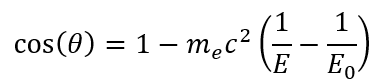
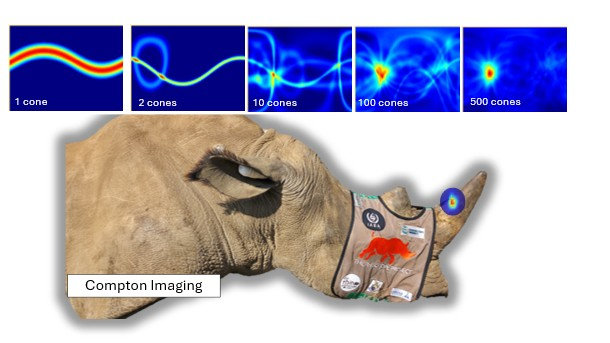
where me c2 is the electron rest mass, E is energy of the scattered photon, and E0 is the energy of the incident photon. Solving for only one angle introduces an angular ambiguity that propagates to a “cone” centered on the lever arm defined by the two photon interaction positions r1 and r2. The cones of photons emitted from the same spot, such as a rhino horn, overlap in the same location forming a "hot spot". The summation of Compton cones for the isotope utilized with the rhinoceros are shown in Figure 1.
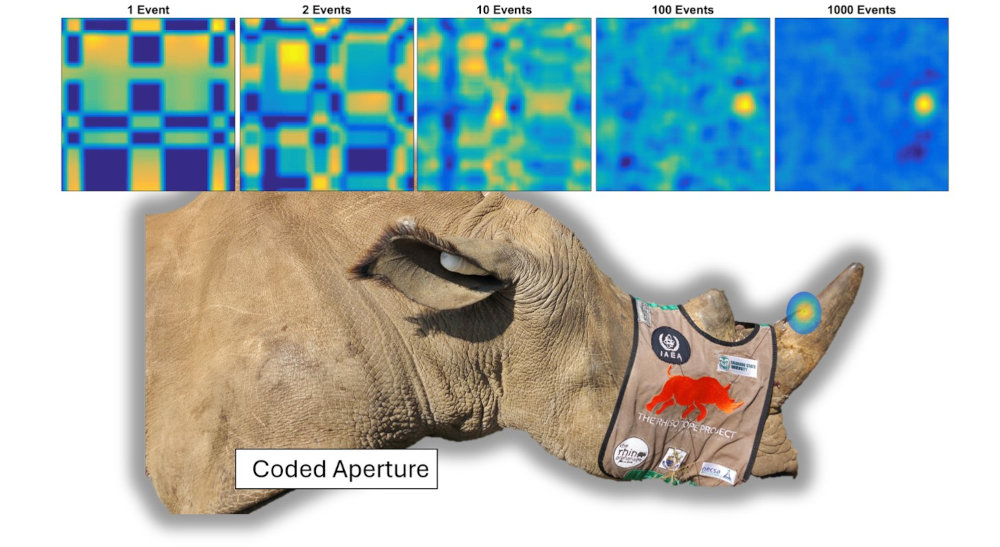
Low energy photons are localized via coded aperture imaging. A tungsten aperture array, coded using a modified uniformly redundant array (MURA), is placed in front of the position-sensitive detector array. Detected photons have preferentially streamed through open elements such that the image response for an individual photon looks like the MURA mask pattern. After summing many photons, each modulated by the mask pattern, the source location is visible as shown in Figure 2. High-energy isotopes are difficult to coded aperture image due to the penetrating power of high-energy emissions. However, some of these photons "downscatter" in the rhino horn near the source. These downscattered photons are less penetrating and are easier to coded aperture image.
Radiation Image to Optical Alignment
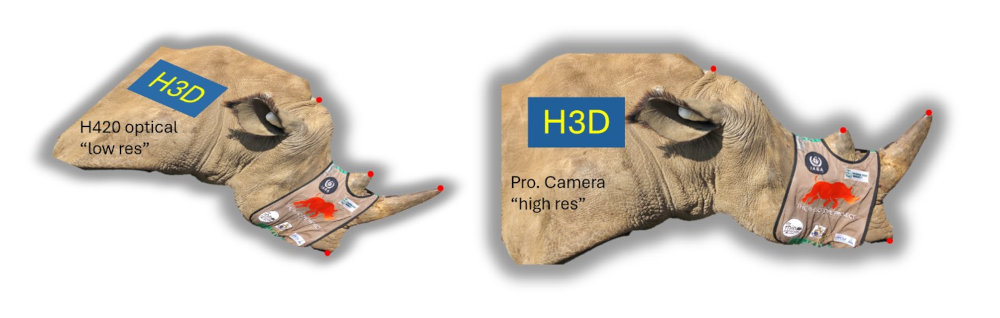
The H420 contains a low-resolution optical camera that is aligned to both Compton and coded aperture radiation images. Low-resolution H420 optical images can be mathematically mapped to a high-resolution image. This mapping is done via selecting common fiducial points in each image. A transform between the two image spaces is calculated, allowing image alignment as shown in Figure 3.
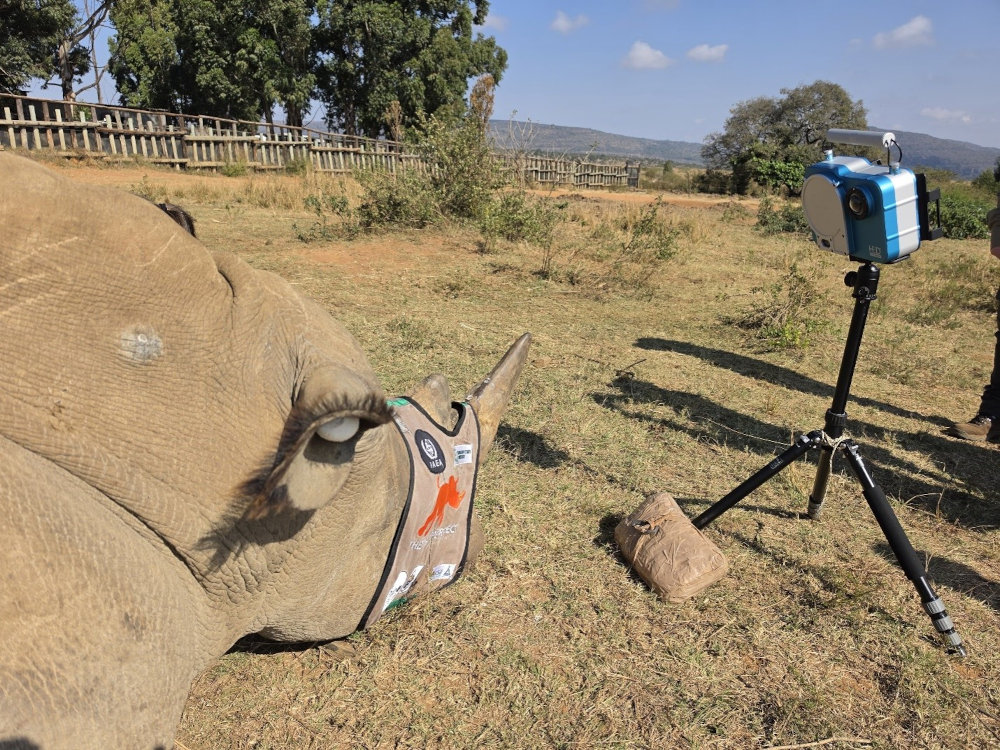
Integrating Radiation Detection with Field Deployment
The combination of radiation detection and imaging technologies plays a critical role in validating and strengthening the RhIsotope Project’s anti‑poaching strategy. While the team’s use of small quantities of a high-energy isotope is a deterrent, the technical imaging methods, Compton imaging for moderate to high‑energy photons and coded aperture imaging for low‑energy photons, allow project scientists and volunteers to visualize precisely where that radiation resides within the rhino horn. These visualizations are essential for confirming correct placement, verifying source strength, and maintaining volunteer safety during the tagging process.
The images recorded during field operations demonstrate how the H420 translates advanced nuclear physics into actionable, real‑world information. The gamma‑ray spectra show clear peaks, and subsequent Compton and coded aperture images reveal the spatial distribution of the isotope within the horn.
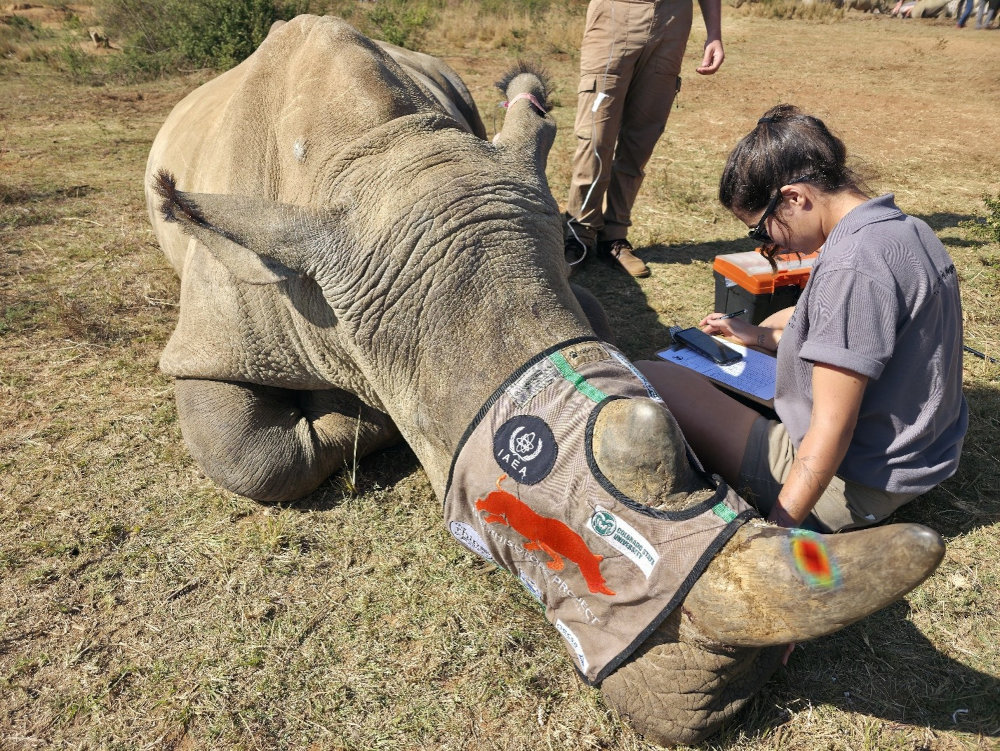
Images collected during deployment highlight how radiation imaging bridges the gap between laboratory tools and conservation work. When aligned with high-resolution optical images, the radiation localizations provide situational awareness for operators in the field. The ability to "see" radiation in context helps ensure the isotopic marker is both secure and easily identifiable if the horn is trafficked across borders.
Figure 5 illustrates this connection clearly: the H420 positioned beside an anesthetized rhino captures the embedded radiation source, producing a definitive radiological fingerprint of the horn. This fingerprint can later be used by customs officials and international agencies to identify trafficked material, turning complex radiation imaging into a straightforward enforcement tool. By merging physics, conservation, and imaging technology, the RhIsotope Project demonstrates how a sophisticated scientific method can directly support wildlife protection.
Project Impact and Next Steps
The RhIsotope Project represents a novel intersection of environmental stewardship and nuclear science, using precise radiological markers and advanced imaging tools to protect one of the world’s most endangered species. Through the integration of H3D’s high‑resolution spectroscopy and real‑time imaging, the project ensures that each isotopically tagged horn is both safe for the animal and unmistakably identifiable to enforcement agencies worldwide. The successful imaging demonstrations with the H420 validate the project’s methodology.
Looking ahead, the expansion of the project into additional regions and the exploration of alternative isotopes will strengthen its global impact. H3D and ThorTech hope to provide future support for the project with H3D’s radiation imaging and portable high-resolution spectroscopy, both of which will be helpful for the project and support its mission.
Click here directly for more information about CdZnTe-based gamma-ray spectroscopy and imaging.
H3D, Inc.
Ann Arbor, MI, USA
©Copyright 2014-2026


Contact Us
Privacy Policy | Conflict of Interest Policy